

Pussy Riot

They were born in Russia, some in Norilsk, some in Moscow, some to single mothers, some to traditional family units with well-paying careers. They have all experienced stifling oppression and what it’s like to be under Putin’s rule.
Individually, they would grow up and start seeking out an outlet in which to focus their growing disgust for the patriarchal bullshit that they and their countrywomen have had to deal with, and together they would become the feminist anarchist collective known for their fearless protests in the face of almost certain violence and imprisonment.
Meet Pussy Riot.
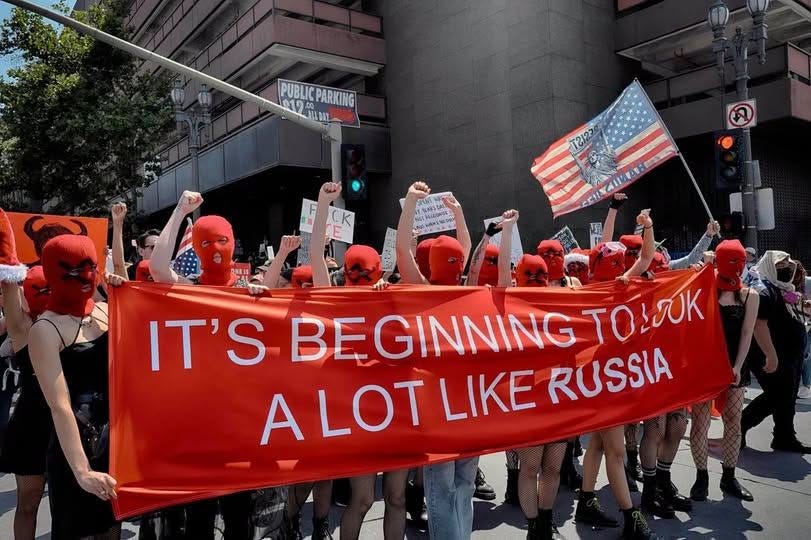
Pussy Riot is a group formed in response to national politics in Russia, their name being two English-language words written in the Latin rather than Cyrillic script, though sometimes the name is transliterated as “Пусси Райот”.
In 2007, Nadezhda Tolokonnikova, also nicknamed Nadya Tolokno, her husband, Pyotr Verzilov, and Yekaterina Samutsevich founded the anarchist art collective “Voina.”
Voina would eventually materialize into the early version of Pussy Riot and continue to evolve over the years, fueled by frustration and anger over antiquated government policies that discriminated against women and, among other grievances, the lack of accessibility to safe and legal reproductive healthcare.
According to Tolokonnikova, Pussy Riot is “part of the global anti-capitalist movement, which consists of anarchists, Trotskyists, feminists and autonomists.” Though they consider themselves more of a collective than “just a band,” a primary delivery device for their message is through their music, with influences such as the Riot Grrrl movement and musical groups such as Bikini Kill, Oi!, Cockney Rejects and by writers, activists and artists like Alexandra Kollontai, Judith Butler, and Simone de Beauvoir.
The media has consistently managed to misunderstand the meaning behind Pussy Riot’s feminism, as the context of it reads different from that of Western feminism. According to Elianna Kan, as stated in the “American Reader,” Pussy Riot’s brand of feminism focused on “the repression of authoritarian regimes that created idealized ideas of sexism, sex, and family life.”
And while so many people, both in Russia and all around the globe, tend to dismiss feminist movements, citing gestures they feel prove that humanity sits in some version of equity, Pussy Riot’s message is that acts of feminist protest in Russia continues to be necessary. It is a fight that’s far from over as post-feminism had not been achieved. When the head of the Russian Orthodox Church still considers feminism as something that could potentially destroy Russia, you could say there’s still a long fucking way to go.
Pussy Riot has a mostly “fluid” lineup. At any given time, they have between 10 and 20 members, some as performers, some remaining more behind the scenes shooting and editing videos that are posted online.
For obvious safety reasons, both for themselves and for their families, most of Pussy Riot’s members prefer anonymity, using aliases when granting interviews and performing under the protection of brightly colored balaclavas.
In one of Pussy Riot’s early protest performances, they played a recording of Pussy Riot’s song ‘Ubey seksista” (‘Kill the Sexist’) at a lecture on feminist punk.
Over the following months, Pussy Riot organized a series of public performances. Their first, in November 2011, was called ‘Release the Cobblestones’. Sampling Angelic Upstarts’ song “Police Oppression,” members of the group performed on top of scaffolding on the Moscow subway, tearing open feather pillows and tossing the contents onto the train tracks.
In February of 2012, they ended up garnering significant notice when they appeared at Moscow’s Cathedral of Christ the Saviour, performing “Punk Prayer” which attacked the Orthodox Church’s support for President Vladimir Putin. The cathedral, representing the hypocritical and unholy union of church and state, made the perfect venue.
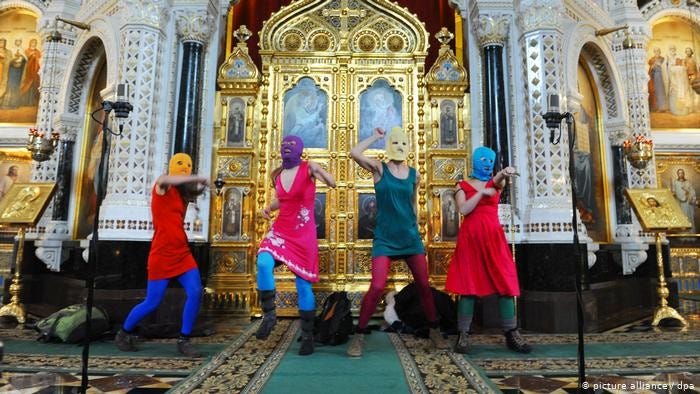
Church officials and law enforcement rushed in and, after a scuffle, broke up the protest.
Tolokonnikova, Samutsevich, and Maria “Masha” Alyokhina were arrested and charged with “hooliganism motivated by religious hatred”.
Once the news spread, people lost their fucking minds, of course, and the threats started rolling in.
Many in Russia felt that the women of Pussy Riot were being made examples of as part of attempts to quash opposition to the government. But the devout that gave zero shits about Pussy Riot’s message saw it as “a gross offence” to the Orthodox faith.
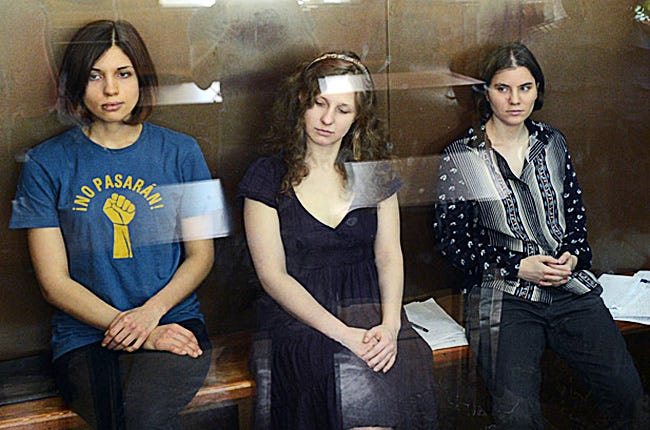
They were held without bail for five months. In July, they were convicted of “hooliganism motivated by religious hatred” and sentenced to two years in prison. Samutsevich was freed on probation in October 2012 after her lawyer successfully argued that she had been stopped by church officials before she could “offend as much” as her bandmates, but Tolokonnikova and Alyokhina remained in custody.
In the years after her release, Samutsevich minimalized her public profile, and tries to keep it that way by regularly changing her email address and phone number.
Pussy Riot’s conviction was met with outcry from civil rights groups, anti-Putin activists, and foreign governments alike. As time went on, their story gained traction around the world, and musicians like Sting, the Red Hot Chilli Peppers, Madonna, and Yoko Ono called for their release.
Tolokonnikova’s and Alyokhina’s sentences were to be finished in Spring of 2014, but an amnesty law was signed by the Russian parliament, which covered thousands of prisoners, mothers being a priority: Tolokonnikova and Alyokhina both had children.
Alyokhina, the first of the two to be released, told a Russian TV channel that the amnesty was a PR stunt and a profanation ahead of the February Sochi Winter Olympics and said that she would rather have remained in prison.
Upon release, the pair promised to continue telling the government to go fuck themselves, and, gesturing as she walked out of a prison hospital in Siberia, Tolokonnikova said that together with Alyokhina she would set up a human rights group to help prisoners. She shouted “Russia without Putin” with the strength and defiance of a woman who wasn’t about to be silenced.
Tolokonnikova has stated that her time in jail had not been wasted, adding: “I became older, I saw the state from within, I saw this totalitarian machine as it is.”
She continues, clarifying that she “did not feel any pride being in jail. It is one of the worst experiences of my life and it’s a terrible, debilitating, degrading experience. But that being said, it was not the end of the life. It did not stop me, and it taught me about conditions in prisons. And I’m really passionate about prisoners’ rights ever since I got out of there. It was an affirmative experience for me, but it also caused trauma that I’m still coping with.”
Pussy Riot members are outspoken supporters of LGBTQ rights. Tolokonnikova and Samutsevich were briefly detained after participating in the forbidden 2011 Gay Pride rally in Moscow after it was broken up by police, the group stating in a statement that their collective included at least one member of a sexual minority.
Tolokonnikova spoke about the importance of transgender rights to the Pussy Riot, stating that she and the rest of the collective wholeheartedly “rejected gender essentialism” and that they “believe you don’t actually have to have a vagina or clitoris to be a woman, and having a clitoris doesn’t necessarily make you a woman.”
“We are always saying that anybody can be in Pussy Riot, and we really mean it.”
Alyokhina and Tolokonnikova, were detained in Sochi by law enforcement in connection with an alleged hotel theft during the 2014 Winter Olympics. They were ultimately released without any charges being brought upon them, and law enforcement tried to downplay it as a non-issue, but footage surfaced showing the women being attacked with horsewhips by Cossacks.
During the 2018 World Cup Final between France and Croatia, Pussy Riot staged a large-scale protest with four of their members running onto the pitch during the second half of the final game of the tournament at Moscow’s Luzhniki Stadium. The protest was screened to an audience of millions across the world with Pussy Riot claiming responsibility for the stunt and declaring that it had taken place in protest of ongoing human rights abuses in Russia. Their demands were the freedom of all political prisoners, to stop illegal arrests at public rallies, to actually allow political competition in the country, and to stop fabricating criminal cases and jailing.
All four members who participated in that protest were arrested, accused of violating the rules for spectators at sporting events and “wearing police uniforms illegally,” and as per usual, they were initially denied both bail and access to a lawyer. In a video of the interrogation, a voice is heard shouting, “Sometimes I regret that it’s not 1937,” referring to the communist-era terror campaign instigated by Joseph Stalin.
The members of Pussy Riot who participated in this protest were banned from attending sports events for three years.
Pussy Riot has released 14 songs and videos, among them “Kill the Sexist,” “Mother of God, Drive Putin Away” and “Make America Great Again,” a 2016 narrative on the shit show that was Trump and his administration. They have yet to release an album, but it looks like that’s about to change with the album “RAGE.” Their title track and video came out February 2021, and the video shoot, which featured over 200 LGBTQ+, feminist, anti-authoritarian young Russians, was raided by the police shortly after the team started filming. The finished product is a conglomeration of bits and pieces of what Pussy Riot were able to film before being interrupted. In its caption on streaming services, they list their demands:
“The release of Russian opposition leader Alexey Navalny, Pussy Riot’s Masha Alekhina (who, in January 2021 was prosecuted for “violation of sanitary and epidemiological rules” after participating in a massive anti-Putin rally), and all political prisoners, we ask the police to stop beating the protesters and stand together with us, we ask Putin and his team to leave the Kremlin ASAP.”
In 2021 they released their collaboration with Rage Against the Machine’s Tom Morello, “Weather Strike,” which fucking SLAPS and I highly recommend turning the volume to a level that will anger your neighbors and give it a listen.
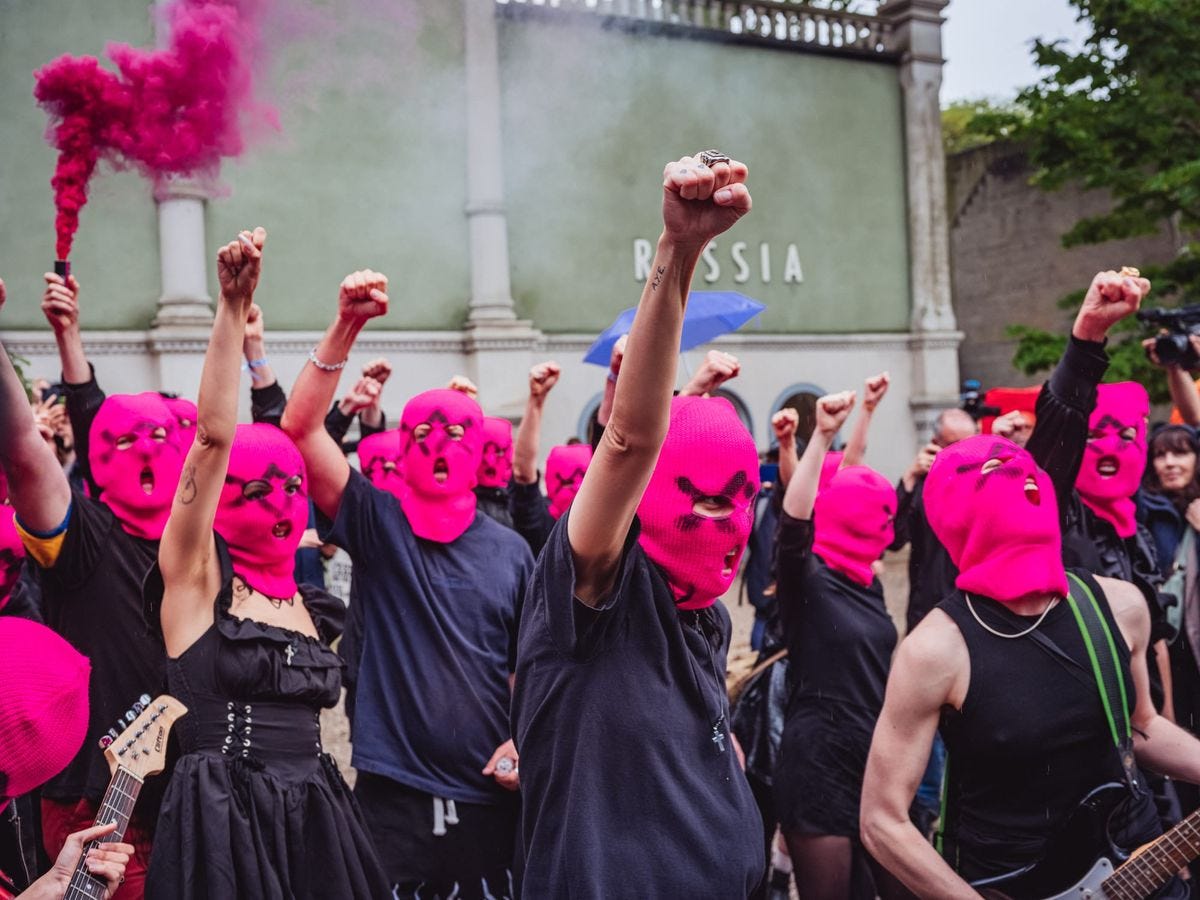
In 2025, Pussy Riot Members were sentenced to Russian Prison...in Absentia. None of them live there now
“A Moscow court has sentenced five members of the exiled feminist art collective Pussy Riot to prison in absentia on charges relating to anti-war protest and performances critical of Vladimir Putin’s regime. The jail terms delivered by Judge Evgeniya Nikolaeva of Moscow’s Basmanny District Court ranged from eight to 13 years, according to Mediazona, the news outlet founded by Pussy Riot.”
Three months later, Russian courts designated Pussy Riot as an extremist organization.
Yeah, none of them live in Russia, so for now, they’re safe from that paritcular nonsense.
The question is asked, especially by their detractors: Will Pussy Riot truly effect change?
“I don’t know,” says Tolokonnikova, “but it’s good enough for me that I’m on the right side of history. And if we fail, it’s important for me ethically to be on the right side.”
“As artists, our goal is to change the world.”
I saw several members perform a piece a few years ago about the what the art collective was doing before they were imprisoned. It was powerful.
I hadn't heard of Pussy Riot until they got a Free Pussy Riot shout out on an episode of South Park. I learned more about them after that